
Less is more... More or Less!
Sep 02, 2016
I often question the effectiveness of many things physios do, and I often take the position that doing less is more. I believe that most treatments and adjuncts to the core principles of education and exercise offer little benefit to patients. This often upsets people, and often I get embroiled in debate, discussion and disagreement around this.

I recently had such a disagreement with some physios when I dared to say I am seeing more people moaning about how they think manual therapy is getting a hard time, and how I think this is a good thing and how I think the crap that surrounds manual therapy needs to be questioned more, not less.
Some thought this was unfair and hypocritical of me and that I should be just as critical of other aspects of our management, such as education and exercise. And I agree, we should all try to be as equally critical of these things.
I am well aware that there is little 'robust' evidence for anything we do as physios, and I am well aware and mention often that things we see often get better regardless if we rub, poke, or exercise them, things often just get better regardless (ref).
This is called natural history, and its physios dirty little secret that is never talked about, and when it is, it usually upsets people who can not accept that they are not essential or needed as much as they like to think.
Nothings Changed!
Now it wasn't long before a few others joined the discussion, with most looking to defend the use of manual therapy, and as usual, some got frustrated with me and my opinions. If you're bored witless you could read the full thread here.
Anyway, the discussion went on and on, and it went off on a few tangents talking about steroid injections and shockwave therapy, and after about 250 tweets later, no one had changed their views or opinions and nothing had been resolved.
But this is ok, this is what debate and discussion is about, and believe it or not, I don't expect to change people's views or opinions much at all, if ever. And although others find it frustrating and a waste of time and energy, I often enjoy these discussions, as they make me think and question my own thoughts and ideas, which is never a bad thing.
But often in these discussions, I do find some knucklehead starts getting their knickers in a twist because I won't change my views or opinions to theirs, or they complain about my tone or attitude and start to get personal and fall foul of the logical fallacies.
It does still amuse me the amount of angst, outrage, and frustration that some have when I challenge or critique their cherished treatments and wont change my mind or opinion to theirs. The sense of entilement these people have is astounding.
Anyway, back to the point at issue, I am now quite comfortable in doing very 'little' with most of my patients, preferring to stick with the core principles of giving advice and education, encouraging movement and then if possible loading it.
My simplistic approach has been neatly visualised here by my mate Tom Goom
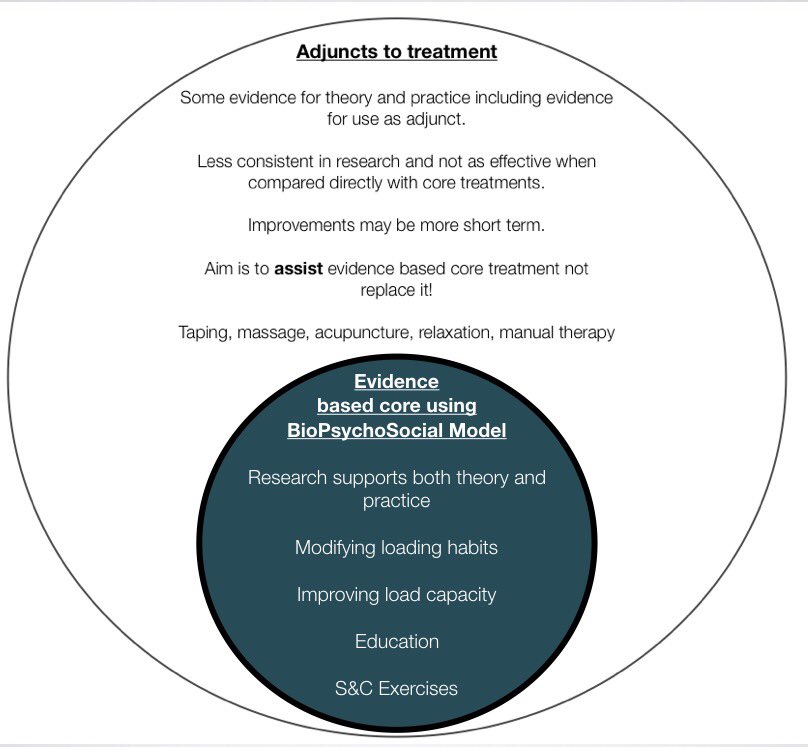
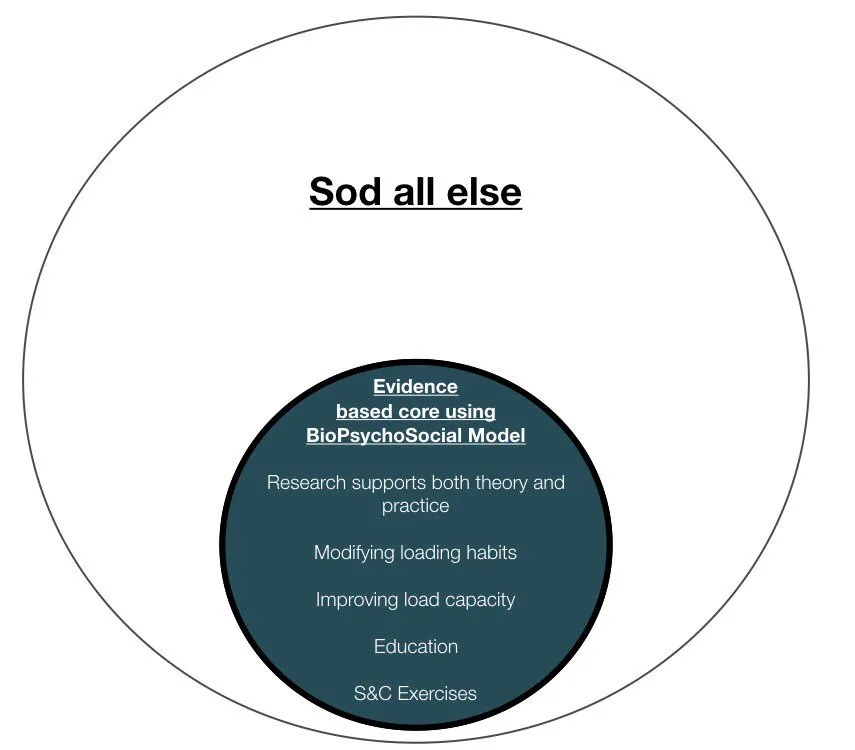
Its so clean, simple and beautiful it makes me weep just looking at it...
However, this simplistic approach is not easy, and it's not doing nothing, in fact, it is a hell of a lot harder than it looks, becuase doing little actually involves doing a lot.
Simple is hard. If you don't believe me, try it.
Try not give that next patient a massage, some tape, or a machine that goes bing when they want it.
Try instead to talk with a patient about how short-term gains may lead to long-term issues.
Try to educate a patient on the passive therapy merry-go-round who has some deeply ingrained beliefs and expectations about passive treatments that they need to take a more active role in their condition and take ownership of their own problems.
Try NOT doing some things and then tell me it's fucking easy!
Respect
However, just because I often don't do other 'stuff' and I question and critique treatments such as manual therapy or injections doesn't mean I think they can NEVER be used!
As a physio with many post-graduate manual therapy certificates and 'qualifications' and now as an extended scope practitioner trained in diagnostic ultrasound and injection therapy, I have manipulated, massaged, and injected many patients.
And I do understand that at times strong patient expectations are to be respected and that when a patient believes something will work, it will work (ref). But this doesn't mean we should do what a patient wants or expects, as sometimes a satisfied patient isn't a healthy patient (ref).

However, let's be honest, not many patients die from a bit of massage or an injection, and so if there is no clear risk or detriment to a patient, some manual therapy or an injection from time to time isn't the worst thing to do.
But we shouldn't stop questioning or challenging the effectiveness or usefulness of these things, as well as highlighting the often overlooked negative aspects of these treatments.
I think it's essential that as a profession we are more critical and sceptical of all we do, in particular with the things described as adjuncts.
Things such as manual therapy, taping, electrotherapy, and all the needle therapies such as acupuncture, dry needling, steroid, PRP, scelerosing, or stem cell injections.
Do any of these things actually do anything of any significance? Are they worth the time, money, and resources, but more importantly, do they have any negative effects?
Detrimental?
Let's first look at corticosteroid injections, which have been shown to have deleterious effects on tendons (ref, ref, ref), and although they may offer short-term benefit in lateral elbow pain, they have been shown to offer no added benefit in the long term and may actually be detrimental (ref).
A common justification for steroid injections is that they can help patients do their exercises more often or better, but this also appears to be questionable (ref).
Next lets look at manual therapy, which has been shown to offer no benefit in chronic low back pain (ref) or acute low back pain over sham or inert interventions (ref). It appears there is no benefit of one type of manual therapy over another (ref). And adding manual therapy to exercises doesn't improve outcomes (ref).
And lets not forget that manual therapy could reinforce to our patients that their pain is tissue or structural based and that its needs to be reduced or modified or that its harmful or damaging (ref).

In my opinion, manual therapy may actually be one of the reasons why we have seen very little improvement in the prevalence of back pain globally over the past decade.
The constant desire by patients and clinicians to reduce pain with medications, injections, and manual therapy may actually be reinforcing negative beliefs and causing people to become less resilient, less robust, and less tolerant to pain.
Let's do a little thought experiment!
Let's pretend that the healthcare system you work for is struggling with funds and resources. That its overwhelmed with demand and understaffed. Let's pretend that you, as a physio have just 6 x 30-minute sessions to make a difference to someone who has had pain for 6 months, who is confused and worried about what is going on, who is afraid of making things worse, who is fearful to move, who has a million questions.
What would you do?
What would you prioritise as essential in your limited time and resources?
What if a patient were paying themselves, would this change anything?
I work in both a struggling healthcare system and a private practice where patients pay for my time. For me, it doesn't matter where I am working; it's still the same. I always prioritise advice and education, encouraging movement, and loading it, this leaves little to no time for anything else.
I never became a physio to rub or poke people.
I never became a physio to stick needles into or tape onto people.
I became a physio to help others who are struggling with life due to pain or injury.
I became a physio to get people moving more, to get them stronger, to get them more resilient.
I became a physio to restore thoughtless, fearless movement in people and to promote the benefits of a healthy and active lifestyle!
And I find that doing 'less' is better at achieving this!
What do you think?
As always, thanks for reading
Adam
Stay connected with new blogs and updates!
Join my mailing list to receive the latest blogs and updates.
Don't worry, your information will not be shared.
I hate SPAM, so I promise I will never sell your information to any third party trying to sell you laser guided acupuncture needles or some other BS.
